Wheelchair seating assessment
The broader clinical assessment within which mapping may be used.



Specialist clinical service
Pressure mapping can add useful information to a specialist seating assessment when its results are interpreted alongside posture, function, skin history and the person’s wider circumstances.
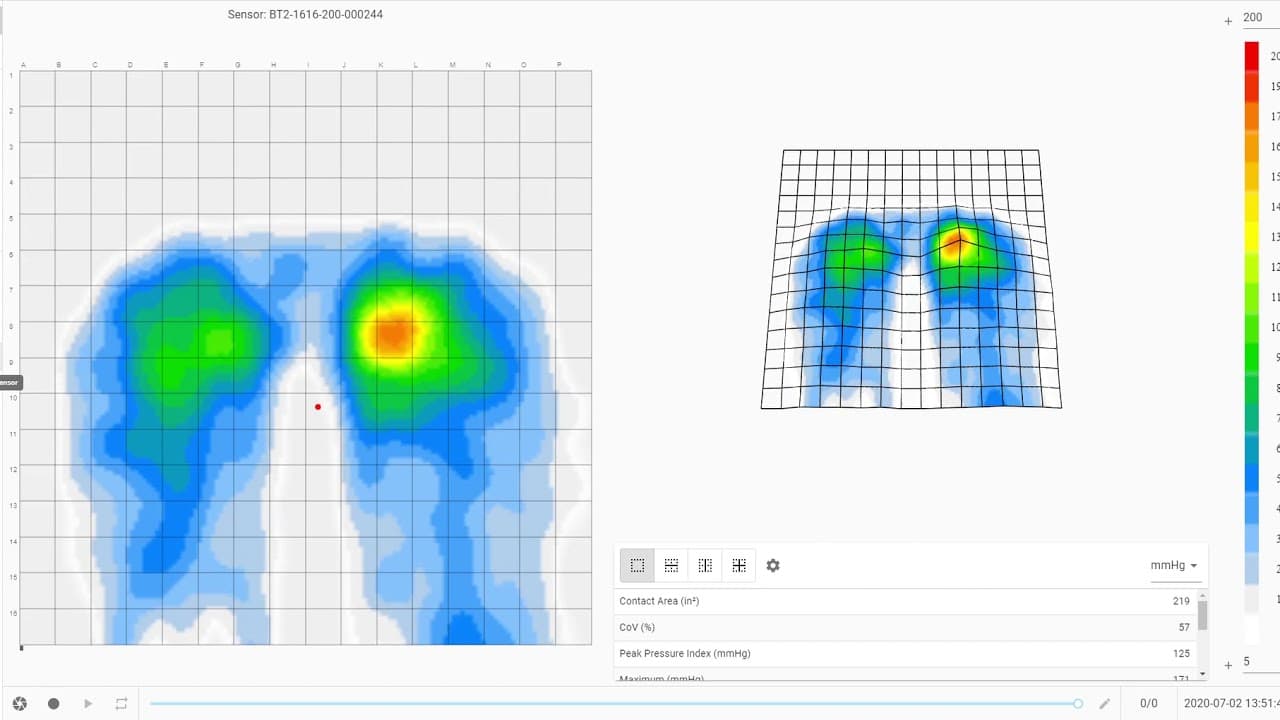
Pressure mapping uses a sensor mat to provide a visual representation of pressure distribution at the support surface during the period measured. It can help a clinician compare positions, adjustments or equipment options and can support discussion with the individual and wider team.
A map is only one source of information. It does not diagnose tissue damage, predict with certainty whether a pressure injury will occur, or establish that one cushion is suitable in every circumstance. Results must be interpreted in context by an appropriately skilled clinician.
Mapping may be considered when reviewing wheelchair seating, exploring changes to a cushion or seating configuration, assessing the effect of posture and support, or communicating why a particular adjustment warrants further trial. Its value depends on a clear clinical question rather than collecting data without purpose.
The clinician will consider relevant history, skin integrity information, ability to reposition, sensation, activity, transfers, time spent sitting, posture, body shape, current equipment and the person’s environment. Concerns about skin or pressure are considered with the person’s treating health professionals where appropriate.
During mapping, the conditions of each reading matter. Position, clothing, equipment set-up, time and movement can all influence what appears on screen. Comparisons therefore need a consistent method and careful interpretation.

Results may support a recommendation to adjust current seating, continue a trial, explore an alternative or retain an existing set-up. They may also show that further clinical information is needed. The lowest visible pressure value is not automatically the best functional or postural solution.
Any recommendation must balance pressure considerations with stability, comfort, function, transfers, mobility, usability and the individual’s priorities. This is why pressure mapping is integrated into clinical reasoning rather than offered as a stand-alone test.
Findings can be included in the agreed clinical reporting and equipment trial process. Where a change is made, fitting, education and follow-up may be needed to confirm that the proposed solution remains appropriate in everyday use.
If there is an immediate concern about skin integrity or a suspected pressure injury, seek timely advice from the person’s responsible healthcare team; this web page is not an urgent clinical service.
Related support
Enquire
Tell us about the person’s circumstances and the support being considered. Our team can help clarify an appropriate next step.